No CAD, No Slicing: Aurora Turns Voice Commands Into Parts
The Day the Mouse Died: How Aurora is Rewriting the Rules of 3D Printing
For the past two decades, if you wanted to make a physical object from a digital idea, you had to go through a gauntlet that would make a medieval scribe weep. You needed CAD. You needed to understand slicers. You needed to know what an infill pattern was and why your print was warping. It was a barrier to entry so high that it kept 3D printing largely in the hands of engineers, hobbyists with too much free time, and industrial manufacturers.
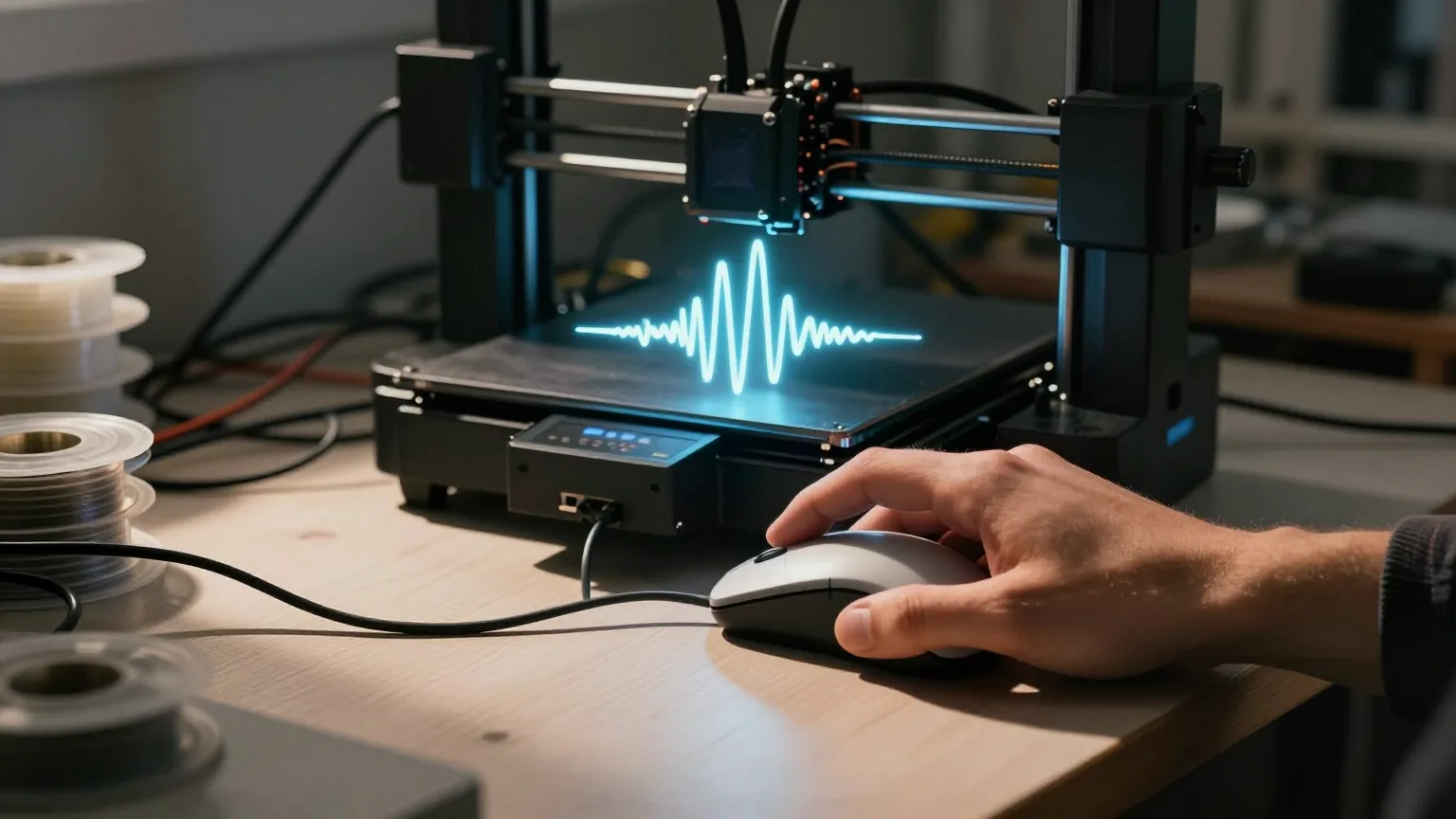
But that era might be ending. In the latest wave of 3D printing news, a new device called the Aurora has emerged with a promise that sounds like science fiction: it can turn a photo, a few words, or even a voice command into a finished 3D part—without CAD or slicing software [1]. The reaction from the industry? A mix of skepticism and desperate curiosity. As one commentator noted, "I'm struggling to believe it. I'm also rather desperate to see it" [1].
This is not just another incremental update to a printer nozzle. This is a fundamental shift in the human-machine interface for additive manufacturing. If Aurora works as advertised, it doesn't just simplify a workflow; it democratizes the very concept of digital fabrication. In this post, we are going to dive deep into what this means for the future of making, exploring the technology behind the hype, the historical context of this "no-CAD" dream, and where this leaves the rest of the 3D printing ecosystem in 2026.
What Exactly Is the Aurora?
Let’s start with the basics. The Aurora is described not just as a printer, but as an intelligent fabrication system. Traditional 3D printers are passive tools; they wait for instructions. The Aurora, by contrast, appears to be an active participant in the design process. According to recent reports from All3DP, the device can interpret multiple input types: a static image (like a photo of a toy or a part), a textual description (a prompt), or a natural language voice command [1].
The key differentiator here is the elimination of the "middleman" software. In the traditional workflow, you design a model in software like Fusion 360 or Tinkercad. You then export that model to a slicer like Cura or PrusaSlicer, which calculates the toolpaths for the printer. The Aurora bypasses both. It likely uses a large language model (LLM) or a multimodal AI to interpret the user's intent, generate a 3D mesh internally, and then directly control the hardware to print the object.
Think of it less like a printer and more like a 3D version of an AI image generator, but one that outputs physical matter instead of pixels. It’s the "text-to-object" pipeline, condensed into a single box on your desk.
The Death of the Slicer: A Technical Leap
To understand why this is a big deal, you have to understand the pain of slicing. Slicing is the computational process of breaking a 3D model into thin layers and generating the G-code instructions for the printer. It is complex, computationally intensive, and often the source of user error.
When the Aurora claims to do this without a standalone slicer, it implies that the slicing logic is embedded directly into the AI model or a specialized neural network on the device. This is a significant engineering feat. It means the system isn't just generating a shape; it is simultaneously optimizing for printability, structural integrity, and material usage in real-time.
This aligns with broader trends in 2026, where AI-assisted design is moving from the cloud to the edge [3]. We are seeing a shift where the "intelligence" of the factory floor is no longer centralized in a server room but distributed across individual devices. The Aurora represents the pinnacle of this edge-AI approach: a device that thinks, plans, and builds autonomously.
Voice Commands: The New Interface
The inclusion of voice commands is perhaps the most radical aspect of the Aurora’s feature set. For years, 3D printing interfaces have been dominated by mice and keyboards. We drag, we push, we rotate, and we zoom. It is a visual, spatial interaction that requires significant cognitive load.
Voice changes this to a conversational interaction. Imagine standing in your workshop, holding a broken bracket, and saying, "Aurora, print a replacement for this, but make it 10% stronger." The system analyzes the object (perhaps via a camera), identifies the geometry, applies the requested modification, and begins printing. This removes the need for the user to understand the geometry at all. They only need to understand the function.
This is a cultural shift. It moves the user from being a "designer" to being a "director." You are no longer drawing the lines; you are describing the outcome. This mirrors the evolution of other industries, from cooking (where we tell a chef what we want rather than how to chop the onions) to software development (where natural language coding assistants are becoming standard).
Historical Context: The Long Road to Simplicity
The dream of "no-CAD" 3D printing is not new. In fact, it has been a holy grail of the hobbyist community since the early days of RepRap. In the 2010s, we saw the rise of "one-click" slicers and cloud-based services that promised to simplify the process. We had apps like "Printify" and various web-based slicers that tried to hide the complexity behind a friendly interface.
However, these tools still required the user to upload a file. They still required a model to exist first. The Aurora takes the next logical step: the model never exists as a file. It exists only as a concept in the AI’s latent space, instantiated physically by the printer. This is a philosophical shift from "file-based" manufacturing to "intent-based" manufacturing.
Historically, the barrier to entry in manufacturing has always been knowledge. You needed to know how to use a lathe, a milling machine, or a laser cutter. 3D printing was supposed to lower this barrier, but it merely shifted the burden from mechanical skill to digital skill. The Aurora aims to remove the digital skill requirement entirely, leaving only the requirement for imagination.
AI-Driven Design: The 2026 Landscape
We are living in a pivotal moment for AI in manufacturing. As of 2026, AI-assisted design is no longer a futuristic concept; it is a reality that makers are actively adopting [3]. The line between "design" and "generation" is blurring. We are seeing tools that can generate complex lattice structures, optimize for weight, and suggest material choices based on the intended use.
The Aurora is the consumer-facing tip of this spear. While industrial players like GM are deploying Stratasys 3D printing across their production networks to prioritize speed in both design and production [4], the Aurora brings this speed to the individual. It suggests that the future of manufacturing is not just about printing faster, but about designing faster. If you can describe a part in three seconds, the time from "idea" to "object" shrinks from hours to minutes.
This has profound implications for prototyping. Engineers can iterate on designs in real-time. You print a version, it doesn’t fit, you say, "Make the flange wider," and a new part is printing before your coffee is cool. This agility is the true power of the Aurora, not just the novelty of the voice command.
Competitors and the Ecosystem: Who Else is Playing?
The Aurora is not operating in a vacuum. The 3D printing industry is crowded with innovation. For instance, Bambu Lab, a major player in the consumer 3D printing space, has been pushing the boundaries of hardware and software integration. Their H3C slicer, for example, allows a fine nozzle to print thin layers and a larger nozzle to print thick ones, side by side [2]. This shows a trend toward "smart" hardware that can adapt its behavior dynamically.
However, the H3C still requires a slicer and a model. The Aurora’s claim is different: it removes the need for the model entirely. This puts it in a unique category. It is competing not just with other printers, but with the entire workflow of CAD and slicing. If successful, it could render traditional CAD software obsolete for a huge portion of the market—namely, the non-engineers who just want to make things.
Other innovations in 2026, such as low-waste multicolor printing [3], show that the industry is focusing on efficiency and aesthetics. The Aurora focuses on accessibility. These are complementary trends. A printer that can print in ten colors is useless if you can’t easily design the object in those colors. The Aurora solves the design bottleneck, while other innovations solve the material and finish bottlenecks.
The Skepticism: Why We Should Hold Our Breath
Let’s be honest: the reaction to the Aurora is healthy skepticism. "I'm struggling to believe it" [1] is a fair response. The technology required to go from a vague voice command to a printable, structurally sound object is immense. There are several hurdles that the Aurora must clear:
- Interpretation Accuracy: If I say "print a hook," does it know if I mean a coat hook, a fishing hook, or a carabiner? Context is king, and AI still struggles with nuance.
- Structural Integrity: AI-generated meshes can be non-manifold or structurally weak. The Aurora must ensure that the generated geometry is not just visually correct, but physically printable and durable.
- Material Constraints: Different materials have different shrinkage rates and thermal properties. The AI must account for these in real-time during the "slicing" process.
- Hardware Limitations: No printer is perfect. The AI must be able to compensate for the specific quirks of the Aurora’s hardware, such as vibration or layer adhesion issues.
Until we see independent tests, the Aurora remains a promise. But the fact that it is being discussed in serious news outlets like All3DP and 3D Printing Industry suggests that it is not just a vaporware concept, but a tangible product with a development timeline [1][5].
Industrial Implications: Beyond the Hobbyist
While the Aurora is likely aimed at the consumer and maker market, its implications for industry are staggering. In industrial settings, time is money. Every hour spent in CAD is an hour not spent on production. If a field engineer can repair a broken machine part by scanning it and asking an Aurora to print a replacement, the downtime is significantly reduced.
Consider the news from SWISSto12, which has cleared the critical design review for S- and Ka-band phased array antennas on 5G demonstration satellites [2]. These are complex, high-precision parts. While an Aurora likely cannot print satellite antennas, the technology behind its AI-driven generation could be scaled up. Imagine a system where a designer inputs a functional requirement, and the AI generates a topology-optimized structure that is then printed by an industrial metal AM machine.
Researchers in China and the United States have already 3D printed titanium alloy single crystals that reach a meter in height [5]. This shows that the hardware is getting more capable. If the software can keep up, we could see a future where the design phase is entirely automated, allowing for rapid iteration in aerospace, medical, and automotive industries.
Cultural Shift: The Democratization of Making
There is a profound cultural aspect to the Aurora. For centuries, "making" has been a specialized skill. Carpenters, blacksmiths, and machinists were part of the working class, but their skills were hard to acquire. The Digital Revolution brought making to the desktop, but it required new skills. The Aurora brings making back to the conversation.
If anyone can make a part by talking to a machine, the barrier to entry is effectively zero. This could lead to a explosion of creativity. We might see more people making custom furniture, unique toys, or personalized medical devices. We might see a shift from a "consumer" culture, where we buy pre-made objects, to a "creator" culture, where we make our own objects on demand.
This is not without risks. There are concerns about intellectual property, safety, and the environmental impact of increased manufacturing. If everyone can print anything, who is responsible for a poorly designed bridge part? Who owns the design if it was generated by AI? These are questions that society will need to grapple with as this technology matures.
The Future: What Comes After Aurora?
If the Aurora succeeds, what is the next step? The logical progression is the integration of multiple modalities. Instead of just voice or photo, we might see systems that can read your mind (via EEG) or scan your body to create custom orthotics. We might see printers that are mobile, following you around the house and printing parts as you need them.
We are already seeing trends toward low-waste and sustainable printing [3]. The next generation of AI-driven printers might be able to predict material usage and minimize waste, printing only exactly what is needed. They might even be able to recycle old prints, feeding the material back into the system.
The Aurora is a proof of concept for a new paradigm: AI-native manufacturing. It suggests that the computer is no longer a tool for humans to use, but a partner that can execute the entire workflow from intent to object. This is a massive leap forward, and it is happening now, in 2026.
Conclusion: The Call to Action
The Aurora is not just a 3D printer. It is a signal that the future of making is intelligent, intuitive, and immediate. It challenges us to rethink our relationship with technology. Are we ready to hand over the design process to AI? Are we ready for a world where the only limit to what we can make is our imagination?
For makers, engineers, and enthusiasts, the call to action is clear: watch this space. Keep an eye on the Aurora and similar AI-driven innovations. Experiment with AI-assisted design tools. Learn how to articulate your design intent clearly. The skills of the future will not be about drawing lines in CAD, but about communicating with machines.
The mouse may be dead, but the spirit of making is alive and well. It is just speaking a new language. And if you listen closely, you can hear it already. It’s saying, "Make it so."
As we move further into 2026 and beyond, the distinction between "design" and "production" will continue to erode. The Aurora is the vanguard of this shift. Whether you are a skeptic or a believer, one thing is certain: the way we create physical objects is about to change forever. The question is not whether this technology will arrive, but how quickly we will adapt to it.