California Law Now Blocks 3D-Printed Firearms
When the Printer Meets the Penal Code: California’s New Ban on 3D-Printed Firearms
Imagine you are sitting in your living room, coffee in hand, watching a spool of plastic filament unwind from a machine the size of a toaster oven. The machine is humming, layer by layer, depositing molten polymer onto a bed. You are not printing a replacement for a broken blender lid or a custom phone stand. You are printing a gun. For the past several years, this scenario has moved from the realm of science fiction and internet conspiracy theories into a tangible, albeit controversial, reality. But as of late 2026, the tides are turning. A new wave of legislative action in California has just crossed the finish line, marking a significant pivot in how we view the intersection of additive manufacturing and public safety.
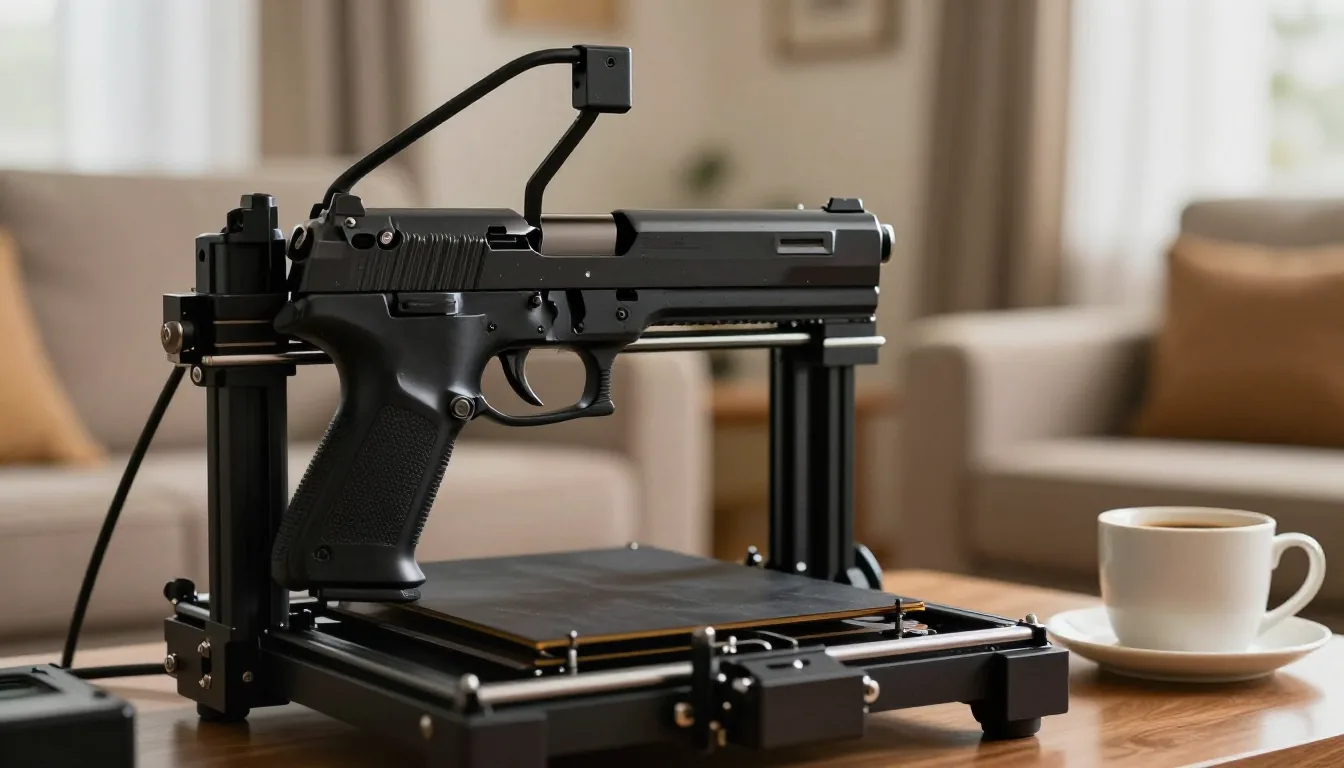
The news broke with a headline that might seem like a clickbait trap but is, in fact, a landmark moment for the industry: a California bill requiring 3D printers to block firearm printing has officially become law [5]. This is not just a local zoning issue; it is a fundamental challenge to the ethos of open-source hardware and the rapid evolution of desktop manufacturing. As we navigate the complexities of this new legal landscape, it is crucial to understand not only what the law says but why it matters, how it fits into the broader history of 3D printing, and what it means for the millions of hobbyists and professionals who rely on these machines today.
The Spark: From Chuck Hull to the Digital Gun
To understand the weight of this California legislation, we must first look back at the roots of the technology. Stereolithography, better known by the abbreviation SLA, became the first 3D printing technology when it was imagined in 1984 by American Chuck Hull, later founder of 3D Systems [2]. The process, which is based on the photopolymerization of a UV-sensitive resin, was initially a tool for industrial prototyping. It was precise, fast, and expensive. It was not, however, a tool for the masses.
Fast forward to the 2010s, and the democratization of 3D printing had transformed the landscape. FDM (Fused Deposition Modeling) printers, which use plastic filament, became affordable enough for the average consumer. This shift brought the technology into homes, schools, and maker spaces. With that accessibility came a dark side. In 2013, the Defense Distributed group published the files for the "Liberator," the first 3D-printed plastic gun. This event sent shockwaves through the legal and tech communities, sparking a debate that has raged for over a decade. The California law is the latest chapter in this long-running saga, representing a state’s attempt to put a digital leash on a physical reality.
Decoding the California Bill: What Does It Actually Say?
The specific details of the new California bill are nuanced, and as with many emerging regulations, the devil is in the details. The core requirement is that 3D printers must have the capability to block the printing of firearm components [5]. This is not a ban on the sale of 3D printers, nor is it a ban on the purchase of plastic filament. It is a functional requirement for the machines themselves. Think of it as a "geofence" for dangerous objects, or perhaps more accurately, a "file fence."
The law assumes a standard is published, which implies that the regulation is tied to technical specifications that manufacturers must meet [5]. This is a crucial distinction. It does not necessarily require every single printer sold in California to have a proprietary, uncrackable software lock. Instead, it likely mandates that the hardware and software ecosystem support the implementation of such blocks. This creates a complex web of compliance. Manufacturers will need to work with software developers to identify and flag files that match the geometric signatures of firearm parts. It is a technical challenge that goes far beyond simple content moderation.
The Technical Challenge: How Do You Block a File?
From an engineering perspective, the task of blocking firearm prints is a nightmare of pattern recognition. 3D printing files are typically in formats like STL or 3MF, which are essentially a list of triangles or a mesh of vertices. They do not contain metadata that says "I am a gun." A gun file is just a collection of polygons. To block it, the printer or its software must analyze the geometry in real-time.
This raises several technical hurdles. First, there is the issue of false positives. A complex mechanical part, a custom drone arm, or a detailed architectural model might share geometric similarities with a firearm component. If the software is too aggressive, it will frustrate legitimate users. If it is too lenient, it will fail to meet the legal requirement. Second, there is the issue of fragmentation. A firearm can be printed in pieces. If the law only blocks complete gun models, a determined individual could print the barrel, the receiver, and the magazine separately and assemble them. The California law likely addresses this by requiring the blocking of "firearm components," but defining what constitutes a "component" in a digital mesh is a moving target.
Furthermore, the rise of multi-material and multi-color printers adds another layer of complexity. A user could potentially use a different material for each part, making it harder for the software to identify the object as a single, coherent firearm. The technology is evolving faster than the regulation can keep up, creating a perpetual cat-and-mouse game between regulators and hobbyists.
The Open Source Backlash: A Philosophical Clash
The 3D printing community is deeply rooted in the open-source philosophy. This philosophy holds that knowledge, designs, and tools should be free and accessible to all. It is the same ethos that built the internet, Linux, and the Raspberry Pi. To many in this community, the California law feels like an affront to this principle. They argue that you cannot un-ring the bell of information. Once the files for a 3D-printed gun are online, they are everywhere. Banning the printer from printing them is like trying to stop a book from being read by banning the library.
Critics of the law point to the futility of such measures. They argue that it only punishes the honest majority of users who want to print toys, prosthetics, or household items, while doing nothing to stop the malicious minority. They also argue that it stifles innovation. If manufacturers are forced to build "black boxes" into their machines to comply with these laws, they lose the flexibility that makes 3D printing so powerful. The ability to print almost anything is the core value proposition of the technology. Limiting that ability, even for a good cause, is seen by some as a slippery slope toward total surveillance and control.
However, proponents of the law argue that this is not about censorship; it is about safety. They draw a parallel to the regulations surrounding the sale of firearms. Just as you cannot buy a gun from a vending machine, you should not be able to print one from a printer. They argue that the burden of safety should not fall on the public, but on the manufacturers of the tools that enable potential harm. In their view, the open-source argument is a red herring. The goal is not to stop the flow of information, but to raise the barrier to entry for those who wish to use that information for harm.
The Industry Response: Compliance or Exit?
How are 3D printer manufacturers reacting to this new reality? The reaction is mixed, to say the least. Large corporations like HP, Stratasys, and 3D Systems are likely to view this as a manageable compliance issue. They have the resources to develop sophisticated software solutions that can identify and block dangerous files. They may even see this as a marketing opportunity, positioning their products as "safe" and "responsible" for corporate and educational buyers.
However, the smaller, hobbyist-focused manufacturers face a different challenge. Companies that sell printers for under $300 do not have the engineering teams to develop complex pattern-recognition software. They may be forced to either outsource this technology, which increases their costs, or exit the California market altogether. This could lead to a fragmentation of the market, where California users are limited to a smaller pool of compliant printers, while users in other states have more choices.
There is also the issue of the "grey market." Many 3D printers are imported from overseas, where such regulations do not exist. It will be difficult for the state to enforce this law on every single printer that crosses the border. This could lead to a scenario where the most affordable printers, and thus the most accessible ones, are the ones that are not compliant. This undermines the goal of the law, as it may inadvertently push users toward non-compliant machines.
Historical Context: The Precedent of the 3D-Printed Gun
The California law does not exist in a vacuum. It is part of a broader historical context of attempts to regulate 3D-printed firearms. In 2018, the US State Department revoked the export license of Defense Distributed, the group behind the Liberator gun, citing national security concerns. This action was widely criticized as an overreach, but it signaled that the government was taking the issue seriously. In 2021, Defense Distributed released the "3D Printed Pistol" and "3D Printed Rifle" designs, further escalating the debate.
These events created a precedent. They showed that the government was willing to use regulatory tools to curb the spread of 3D-printed firearms. The California law is a more direct and proactive approach. Instead of targeting the designers or the files, it targets the machine itself. This is a significant shift in strategy. It suggests that the government is moving from a "whack-a-mole" approach, where they try to take down specific files, to a systemic approach, where they try to build safeguards into the technology itself.
The Global Perspective: A Patchwork of Regulations
It is important to note that California is not the only jurisdiction grappling with this issue. Other states and countries are watching closely. Some may adopt similar laws, while others may take a different approach. This could lead to a patchwork of regulations, where the rules for 3D printing vary from state to state. This is a challenge for manufacturers, who would have to tailor their products to different markets. It is also a challenge for users, who may need to know which laws apply to their specific location.
Internationally, the situation is even more complex. The EU has its own set of regulations regarding consumer safety and data privacy. The UK has its own laws. China has strict controls on the export of certain technologies. The California law may serve as a model for other jurisdictions, or it may be seen as an outlier. The outcome will depend on how effective the law is in achieving its goals, and how it is perceived by the global community.
The Impact on Education and Research
One of the most concerning aspects of the California law is its potential impact on education and research. 3D printing is a powerful tool for teaching engineering, design, and computer science. Students use it to bring their ideas to life, to test their prototypes, and to learn about the manufacturing process. If the law is implemented in a way that restricts the types of objects that can be printed, it could hinder this educational process.
For example, a student designing a mechanical arm for a robotics project might find that their design is blocked by the software because it resembles a firearm component. This could be frustrating and demotivating. It could also stifle creativity, as students may be afraid to explore designs that are close to the boundary of what is allowed. This is a risk that must be carefully managed. The law should be designed to allow for exceptions for educational and research purposes, but defining those exceptions is a complex task.
The Future of 3D Printing: A New Era of Responsibility
Despite the challenges, the California law may also mark the beginning of a new era for 3D printing. An era of responsibility. The technology has grown up, and with that growth comes the need for greater accountability. The days of "anything goes" are over. The 3D printing industry must now engage with regulators, policymakers, and the public in a meaningful way. It must demonstrate that it is a force for good, and that it can be trusted with the power to create physical objects.
This will require collaboration. Manufacturers, software developers, researchers, and policymakers must work together to develop standards and best practices for safe 3D printing. They must also invest in research to develop better detection algorithms, more secure software architectures, and more transparent reporting mechanisms. The goal is not to restrict the technology, but to make it safer and more reliable for everyone.
What Should You Do? A Call to Action
If you are a 3D printing enthusiast, what should you do in the face of this new law? First, stay informed. Follow the news and the regulatory developments in your area. Understand what the law says and how it affects you. Second, engage with your local government. Attend public hearings, send letters, and voice your concerns. Your voice matters. Third, support the development of safe and responsible 3D printing practices. Use your printer responsibly, and do not attempt to circumvent safety measures. Finally, stay optimistic. The 3D printing community is resilient, and it has the power to shape the future of this technology. The California law is a challenge, but it is also an opportunity. An opportunity to prove that we can build a future where innovation and safety go hand in hand.
Conclusion: The Printer in the Crosshairs
The passage of the California bill requiring 3D printers to block firearm printing is a watershed moment for the additive manufacturing industry [5]. It marks a shift from a wild west of digital fabrication to a more regulated and responsible future. It is a reminder that with great power comes great responsibility. The 3D printer is a powerful tool, capable of creating anything from a simple toy to a complex machine. But with that power comes the potential for harm. The California law is an attempt to mitigate that harm, and while it may not be perfect, it is a step in the right direction.
As we look to the future, we must remember that technology is not neutral. It reflects the values and priorities of the society that creates it. The 3D printing community has the opportunity to shape those values. We can choose to be a community that prioritizes safety, responsibility, and the common good. Or we can choose to be a community that resists regulation and risks being shut down. The choice is ours. And as the spool of filament unrolls, layer by layer, we must decide what kind of world we want to build. One where the printer is a tool for creativity and innovation, or one where it is a target for fear and suspicion. The answer, as always, lies in our hands. Or rather, in our printers.
So, the next time you sit down to print something, take a moment to reflect on the power in your hands. You are not just creating an object; you are participating in a global movement that is reshaping the way we make things. And in that movement, we have a choice. A choice to be responsible, to be safe, and to be part of a future where technology serves humanity, not the other way around. Let’s make that choice. Let’s print a better future.